
Rutba Books on film: an invoice paid, the suppliers settled and the year so far
A four and a half minute film follows the books of Northbank Trading, an invented wholesaler: what is owed both ways, a payment recorded against an invoice, supplier bills settled, cash flow weeks ahead, and an income statement read from the ledger.
· 2 min read

Rutba Books keeps invoices, receipts, supplier bills, payments and expenses on the same ledger the accountant works in. Every document posts its own journal, so the start page never needs adjusting by hand. The film below shows the books of Northbank Trading, an invented supplier to cafes, delis and grocers, and every figure in it is made up.
Rutba Books: the money side of a trading business (4:31).
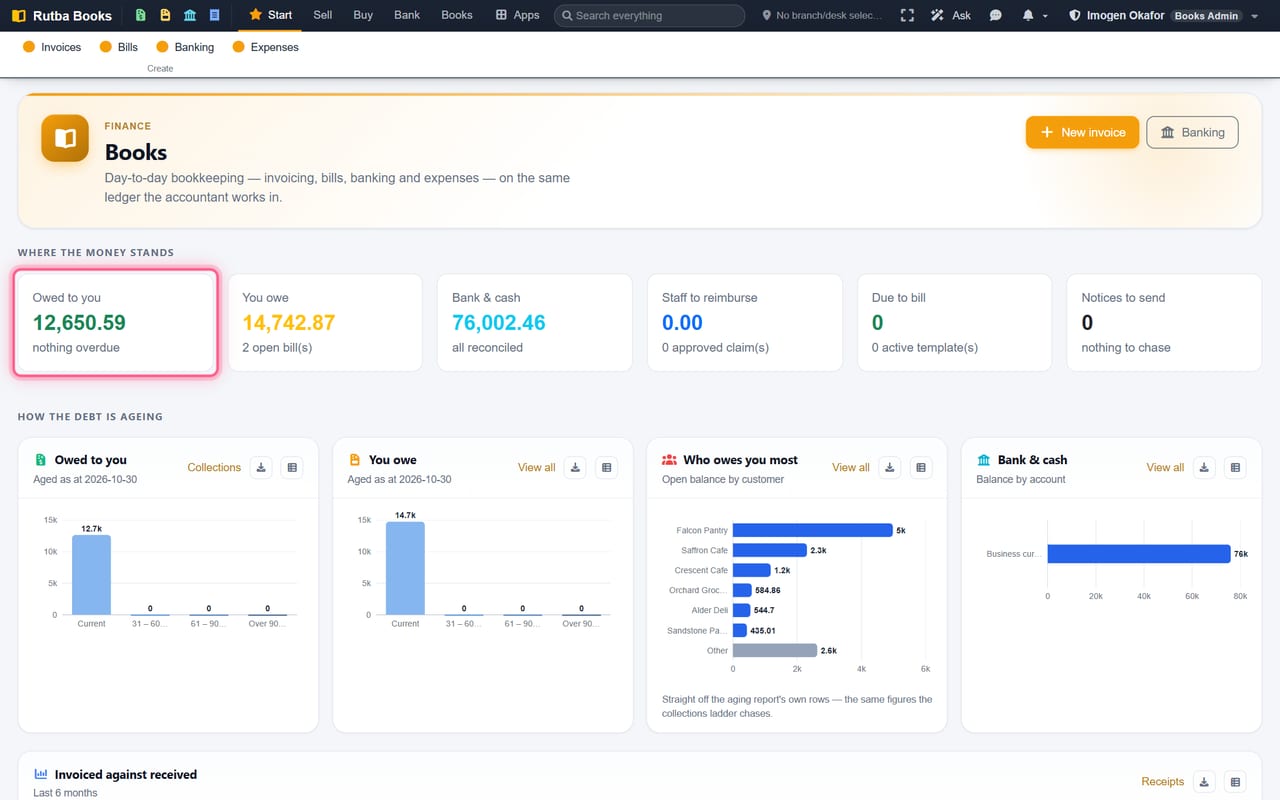
Where the money stands
The start page answers the first questions anyone asks of a business: what customers owe, what the business owes its suppliers, and what is in the bank. Below that, debt is aged in both directions, and six months of invoicing sit beside the money that actually came in, so a slow month for collections shows at once.
Getting paid
A cafe’s invoice is open with its full balance due. Recording the payment takes a moment: the amount is filled in from the balance, and the bank transfer is recorded against the business current account. One press of Record, and the invoice is paid. The payment becomes a numbered receipt allocated to the invoice it settles; a receipt can pay several invoices, and cancelling one gives every invoice its balance back. On the start page, what customers owe has gone down by exactly that amount.
Paying suppliers and running costs
Each supplier bill keeps its own number and the supplier’s reference, and Books checks whether it needs approval before it is paid. Each payment settles the bill it was meant for, so a supplier statement can be checked line by line. Costs that never come with a bill, such as the warehouse rent, energy and diesel, are kept as expenses, each posted to its own account.
Cash ahead and the year so far
The bank account is tied to its ledger account, and imported statements are matched against what Books already knows. Cash flow looks ahead week by week, placing each invoice and bill on the day it falls due: nothing is estimated, and every figure is a document you can open. The accountant reads the income statement for the year in Rutba Accounts, on the same ledger, with no export: here a gross margin of about a quarter of every pound sold.
The film says plainly that Books does more than it can show: credit notes, a collections ladder for late payers, approval before payment, payment runs as a bank file, fixed assets and staff expense claims.
Rutba Books
Invoices, bills, payments and expenses on the ledger your accountant works in.
See the product

